
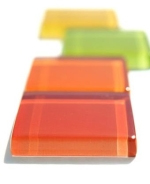

Perimeters Without End: The Appeal Of Glass Tiles
Ever drifting down the stream –
Lingering in the golden gleam –
Life, what is it but a dream?Lewis Carroll, Epilogue to Through the Looking Glass
We inevitably fill our homes with the reflective stuff of dreams. Personally charged artifacts that line our shelves and dressers, as well as inspiring functional objects – things like well designed furniture, specialty faucets, fixtures and appliances – all of these things support our aspirations. Our ability to dream can be even be nurtured by the four walls that hold us.
Glass has the potential to transform walls and floors from the role of blunt physical boundary into mediums of uncertain beginning and end - which, in turn, registers in us as a new sense of possibility. In a thoroughly modern way, glass tiles fulfill what marketing futurist Melinda Davis describes as the "New Primal Desire – the quest for the imaginational experience.” 1
The roots of glass tiles have been traced to the Byzantine mosaic tradition. Historical glass wall coverings included mosaic murals, moldings and stained glass. These things inspire glass designers today, although modern designs may be a reflection of something far more contemporary and ubiquitous than Byzantine and Medieval cathedrals.
ASID member Rahnee Gladwin is a Texas Hill Country interior designer who works exclusively with tile and stone. Her observation: customers are also drawn to glass tiles out of unconscious sense of familiarity. “Light comes out of glass tiles as if they were backlit,” she explains, “giving the kind of warmth we associate with a fireplace, including electronic fireplaces, like TVs or computer monitors. People are naturally drawn to them because they are, in this technological age, accustomed to looking at light in this way.”
Glass tiles aren't always easy to install, and they aren't cheap. Original lines start at $25 a square foot, at least ten times the price of standard clay or ceramic tile. Depending upon what you buy, glass tiles for a kitchen wall can cost well over $2,000; enough tiles for a small back splash easily come in at $500. What is more, installation requirements are particularly stringent for glass. So we may see their appeal, but who can afford them?
The people driving the demand for glass tiles and other high-end kitchen products aren't necessarily conspicuously wealthy, according to marketing consultant Leslie Hart. These products are bought by “the most lucrative lifestyle segment for the kitchen and bath industry, the new middle class” 2 – that is the self-made people who are thriving in the Information Age, and they have an unusually strong appetite for beauty in utilitarian objects.
In Bobos is Paradise, author David Brooks identifies a large sector of the new middle class as “bourgeois bohemians” – a group of creative professionals that has a genuine interest in what calls “the perfectionism of small things.” 3
Special appeal
In the past ten years there has been an explosion of technological innovation in domestic glass products, enabling smaller runs of classic looking and unique products to enter the market. Is glass tile just a fad? It seems unlikely. Tiles made out of glass fit the profile of the new middle class extremely well; chances are, they will be with us for years to come:
- Glass tiles reflects our desire to transform the ordinary.
- They can shed familiar lighting- similar to the diffused light from films, TV and our computer monitors.
- Glass tiles come from a glorious artistic tradition: mosaic art.
- Glass is a recyclable product; some variants, such as cast glass tile, are also made from recycled glass.
- Glass tiles can intensify light and color, brightening a space without extra lighting.
- Glass tiles can enhance resale value of our homes.
Beauty, light, added resale value, historical context, social responsibility: as a consumer product, glass tiles satisfy all of these criteria.
Like specialty coffees and high end appliances, glass tiles are further
evidence that we demand more appeal and more resonance in our everyday objects.
If Gladwin is right, we're drawn to glass tiles because they simply and
elegantly reflect our times, transforming a wall from a sheer physical boundary
into a medium of diffused light. Despite the expense, people are drawn to
glass tiles because they promise to delimit the walls that hold us. In a
subtle way, they give our rooms space to dream.
